
Every World Cup cycle brings the same question back into focus: Can Portugal finally lift the trophy?
It’s a fair question. Portugal have produced some of the most technically gifted footballers in modern history, have won major international titles, and consistently qualify for the tournament. Yet, despite the talent, the World Cup has remained elusive.
To answer this question honestly, we need to move beyond emotion, star power, and past reputations—and look at structure, balance, mentality, and timing.
Portugal’s Talent Is Undeniable, but Talent Alone Isn’t Enough
Portugal’s squad depth is no longer limited to one or two world-class names. Over the last decade, they have developed strong players across Europe’s top leagues.
From defense to midfield to attack, Portugal can compete technically with almost any nation.
However, World Cups are rarely won by the most talented squad on paper. They are won by teams that combine talent with tactical clarity, discipline, and adaptability. This is where Portugal’s World Cup history becomes relevant—they have often looked brilliant in moments, but inconsistent over the full tournament.
The Cristiano Ronaldo Factor: Strength and Complexity
Cristiano Ronaldo’s presence has defined Portugal for nearly two decades. His mentality, professionalism, and influence raised the national team’s standards. Portugal’s Euro 2016 victory would not have been possible without the culture he helped build.
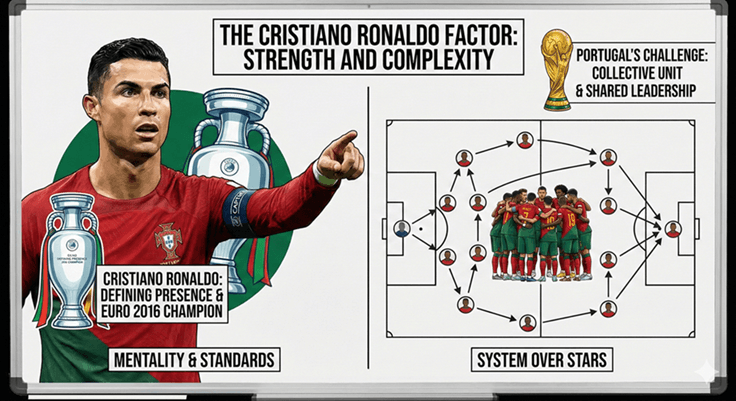
At the same time, a World Cup team cannot depend emotionally or tactically on one individual. Modern international football rewards systems over stars. For Portugal to truly challenge for the World Cup, they must function as a complete unit—where leadership is shared, responsibility is distributed, and decisions are made for the collective, not the narrative.
Midfield Control Will Decide Portugal’s Ceiling
Portugal’s best World Cup performances historically came when they controlled midfield games, not when they chased them.
In knockout tournaments, matches are often decided by rhythm, positioning, and patience rather than attacking flair.
If Portugal can consistently dominate midfield battles—retaining possession under pressure, transitioning quickly, and defending compactly—they give themselves a real chance against elite opponents like France, Brazil, or Argentina.
Without that control, even a talented squad can look fragile.
Football Tournament Is About Margins, Not Perfection
The World Cup is not a league competition. There is no time to recover from slow starts or tactical experiments. One mistake, one red card, or one poor substitution can end a campaign.
Portugal’s challenge has often been managing these fine margins:
- When to defend deep and when to press
- How to manage big moments without panic
- How to stay composed when matches don’t go as planned
Teams that win the World Cup are rarely flawless—they are resilient, pragmatic, and mentally strong under pressure.
Mentality: From Hope to Belief
Portugal have already crossed the psychological barrier of winning major tournaments with the Euros and the Nations League. That matters. Teams that have never won often carry invisible pressure.
However, World Cup belief is different. It requires quiet confidence, not expectation. The most dangerous teams are usually the ones focused on execution rather than prediction.
If Portugal approach the World Cup with patience, tactical discipline, and emotional control, they move from possible contenders to serious challengers.
So, Can Portugal Win the World Cup?
Yes—but not automatically.
Portugal can win the World Cup if:
- They prioritize structure over star power
- They maintain midfield balance throughout the tournament
- They adapt tactically match by match
- They manage pressure with maturity, not emotion
If they chase the tournament with nostalgia or over-reliance on individuals, the gap between potential and achievement will remain.
World Cups are not won by reputations or predictions. They are won by teams that peak at the right moment, make fewer mistakes than others, and stay united under pressure.
Portugal have the tools.
Whether they assemble them correctly—that will decide their fate.
Thanks for the above information. Very interesting to read
I would really love to read if write something about mobile addiction.
каркасный дом санкт петербург — отличный выбор для тех, кто хочет быстро и экономично получить уютный и долговечный дом.
Это даёт возможность уменьшить затраты на материалы и заметно сократить время строительства.
Надёжная паро- и гидроизоляция предотвращает накопление влаги и появление плесени внутри конструкции.
Использование современных теплоизоляционных материалов уменьшает теплопотери и эксплуатационные затраты.
Системы с рекуперацией тепла делают вентиляцию энергоэффективной и комфортной для жильцов.
Каркасные дома предлагают гибкость в планировке и дизайне интерьера.
Фасадные решения для каркасных домов разнообразны и позволяют добиться желаемого внешнего облика.
Быстрое возведение сокращает расходы на оплату труда и аренду техники.
Хорошая репутация строителей снижает риски ошибок и дополнительных затрат во время строительства.